Let us follow Nehemiah’s example


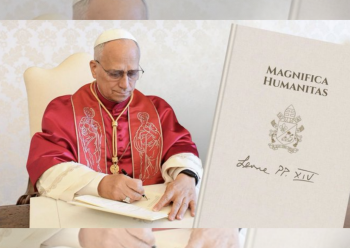
On Whit Monday, the feast of Mary, Mother of the Church, in the Paul VI Hall, the Pope was personally present at the official presentation of an encyclical of his own authorship. This was the first time a Pontiff had personally attended such an event, and the gesture likely reflects Leo XIV’s desire to lead by example, given that, in his own words, the task before us is “together to find the way for humanity, in this time of artificial intelligence”.
The message of this encyclical, Magnifica Humanitas (meaning Magnificent Humanity), is first and foremost that “artificial intelligence now needs to be ‘disarmed’”. “The word is strong, I know, but deliberately chosen because this moment needs words capable of attracting attention, awakening consciences”, emphasised the Holy Father. “Artificial intelligence now demands to be ‘disarmed’, freed from logics that turn it into an instrument of domination, exclusion and death”, he clarified, before adding that disarming, however, is not enough because “we must build”.
In highlighting the heart of his message, the Holy Father points to the example of the biblical prophet Nehemiah who, faced with the ruined walls of Jerusalem, rallied a discouraged people to bring about a revival. “Nehemiah’s effort speaks to our time. Artificial intelligence can be a construction site of history from within a horizon of communion, in which technical progress learns to serve human life”, the Pope observes. Summing up his message, he adds: “Let’s not fear artificial intelligence, but constantly keep the question of the human in play”.
In the introduction to the encyclical, Leo XIV draws upon two biblical images: the building of the Tower of Babel (Gen 11:1–9) and the rebuilding of the walls of Jerusalem (Neh 2–6). Referring to Babel, he observes that “when a city is built on pride and the claim to self-sufficiency, communication breaks down, languages are confused and people no longer understand each other”. In contrast to this fragmentation, the Pope emphasizes the pursuit of unity, recalling how, after the Babylonian exile, the prophet Nehemiah worked to rebuild Jerusalem, which lay in ruins: “He did not impose solutions from above. He convened the families, assigned each of them a section of the wall to rebuild, listened to their concerns, coordinated their efforts and addressed any opposition. The narrative shows how the city is reborn, not through the initiative of one man, but through the shared responsibility of all: men, women, priests, artisans, heads of households and young people all play a part. It is an undertaking with God at the center, which rebuilds relationships before rebuilding with stones. Thus, ancient Jerusalem rediscovers a common language — not one of uniformity, but one of communion, namely the harmony that arises when all persons assume their own role and recognize that their strength comes from the Lord”. According to the Pope, with reference to technology and the ongoing digital revolution, the choice therefore lies “between constructing Babel or rebuilding Jerusalem; between a power that claims to dominate the heavens and a people who work together in the presence of God to rebuild the walls of fraternal coexistence”.
In this spirit, Leo XIV issues a heartfelt appeal to all the Catholic faithful, to all Christians, and to all men and women of good will: “Like Nehemiah, let us pray, plan wisely and work perseveringly, placing God at the forefront of our actions and the human person at the center of our choices. Thus, the “rejected stones” — the poor, the sick, the migrants and the lowly among us — will become the cornerstone, and a solid, welcoming common home will emerge on the earth, where love and faithfulness will finally meet, and righteousness and peace will embrace (cf. Ps 85:10). This is the blessing we implore from God; and the task that stands before us is that of being builders of communion, rather than architects of Babel. We are to be servants of the coming Kingdom, instead of lords of towers destined for ruin. With the heart of a shepherd and a father, I ask everyone to abandon the construction of yet another Tower of Babel and to join forces in building up the common good, so that humanity will never lose its beauty, and the world once again will come to recognize the human heart as the place where God desires to dwell”.
Magnifica Humanitas sets out in detail the history of the Church’s social teaching, together with its foundations and guiding principles. The encyclical also explores the potential of artificial intelligence, subordinating it to a Christian humanist vision, placing particular emphasis on the need to safeguard the dignity of work throughout the digital transition. Furthermore, this seminal text outlines a horizon of commitment for all, that “civilization of love” which corresponds to the vision of Saint Paul VI, that is, a veritable “construction site of hope”. “The civilization of love is no naïve utopia, but a demanding project, which consists in translating charity into structures of justice, giving institutional form to fraternity and regarding others — whether individuals or peoples — as allies necessary for building the common good”.
In conclusion, the encyclical presents the Virgin of the Magnificat as a model, for the “hope, which sustains our actions in the world is prayer”. “Before Elizabeth who announces to her that she has become the mother of the Lord, Mary bursts into a hymn of praise and joy. Her soul magnifies the Lord, and her spirit rejoices in God her Savior, for he chose a young, poor and humble girl for his plan of salvation. Mary suddenly sees all of history through the lens of this revelation” writes Leo XIV, affirming from an eschatological perspective that “God takes the part of the lowly. His plan is one that is often hidden beneath the opaque context of human events that see ‘the proud, the mighty and the rich’ triumph. Yet his secret strength is destined in the end to be revealed”. In the age of artificial intelligence, the Pope urges all human beings to become “weavers of hope”, with the same faith as Mary.
François Vayne
(May 2026)