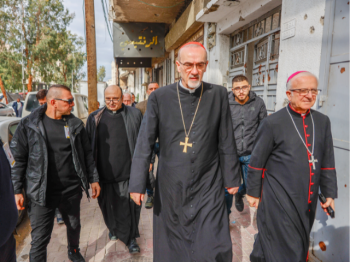
“The Holy Land is not merely a place to be supported, much less a problem to be solved: it is a source”

An interview with Cardinal Pierbattista Pizzaballa

Print Mail Pdf

Intervista a Pizzaballa - 1

Your Eminence, the constant conflict in the Holy Land seems almost perpetual.  In such a context, how can we continue to believe that peace will one day be possible without appearing idealistic or naïve? In what way can Jesus’ parable of “the wheat and the weeds grow together” (Matthew 13:24–30) help us to work for peace, knowing that conflict s almost intrinsic to human interactions in the Holy Land?

The presence of evil, the weeds, will come to an end only with the second coming of Christ. All of us would like evil to be overcome as soon as possible and to disappear from our lives. However, this is not so. We know this, yet we must learn time and again to live with the painful awareness that the power of evil will continue to be present in the life of the world and in our own lives. This is a mystery, however harsh and difficult, which belongs to our earthly condition. It is not a matter of resignation. On the contrary, it is an acknowledgment of the dynamics of life in the world, without any form of escape and without fear, without sharing in them and yet without concealing them either.

Peace, therefore, must not be confused with the disappearance of evil, with the end of wars, or with all that evil, that is Satan, instills in the hearts of human beings. We all desire that this situation of war, together with its consequences for the life of our communities, may come to an end as soon as possible, and we must do everything possible to bring this about. Yet we must harbor no illusions. The end of the war would not, in any case, mark the end of hostilities or of the suffering they would continue to cause. From the hearts of many there will still arise desires for revenge and anger. 
Intervista a Pizzaballa - 5

The evil that seems to govern the hearts of many will not cease its activity, but will remain constantly at work, I would even say in a creative manner.  For a long time to come, we will have to deal with the consequences that this war has had on the lives of people. Yet precisely in this context, to believe in peace means not to serve the power of evil, but to continue to allow the seed of the Kingdom of God to grow, that is, to plant a seed of life in the world. In this context of death and destruction, we wish to continue to place our trust, to join ourselves to the many people here who still have the courage to desire what is good, and together with them to create contexts of healing and of life. Evil will continue to manifest itself, but we will be the place, the presence that evil cannot overcome, a seed of life, in fact.

Among all the biblical names attributed to Jerusalem, which ones inspire you most in light of the present situation? Could you comment on them for us from the perspective of an invincible hope?

Two names are especially significant to me in the present context: “City of Peace” (one of the etymological meanings of Yerushalayim) and “Bride” (or “the Promised Bride”), especially as she is described in the Book of Revelation as the Bride of the Lamb.

“City of Peace”: today this name appears as a painful oxymoron, literally a contradictio in terminis. Yet this name remains a prophecy, an unfulfilled vocation. It reminds us that peace is not merely the absence of war, but the fullness of life, reconciliation, and justice. Despite the deep wounds, this name keeps alive the hope that God has not abandoned His plan for this city.

“Bride”: in the Book of Revelation, Jerusalem is also presented as a bride “adorned for her bridegroom” (Rev 21:2). This image evokes intimacy, covenant, and the beauty intended by God. Today Jerusalem is torn, divided, and wounded, yet the image of the bride reminds us that her true identity is given to her from above, that she is loved and awaited. This vision allows us not to reduce Jerusalem to her present conflicts, but to see her with the eyes of faith, as a reality still unfolding, called to communion. These names inspire an invincible hope because they point beyond visible reality toward God’s promise. They invite us to work, even in the darkness, so that these names may gradually become a reality lived by all.

Intervista a Pizzaballa - 2

The New Jerusalem, as described in the Book of Revelation, is presented as the Bride of the Lamb (Rev 21:9). Is it already possible to discern signs of the New Jerusalem descending from heaven within today’s torn Jerusalem, where communities scarcely communicate with one another? What are these eschatological signs, and, more broadly, how can we hasten, through our actions, the coming of the New Jerusalem in the midst of this world marked by evil and violence?

Yes, certainly. Even if only to a modest extent, signs of the New Jerusalem, the Bride of the Lamb, can be discerned within today’s torn Jerusalem:

The presence of “wounded healers”: there are people—believers from different communities, humanitarian workers, artisans of dialogue—who, though themselves wounded by the conflict, continue to weave relationships, to heal, and to listen. These people already embody a style of relationship inspired by the New Jerusalem: a style in which one is not defined by hatred, but rather by steadfast love and hope.

Fragile spaces of encounter: despite prevailing distrust, there are still spaces (churches, local initiatives, universities) where interreligious and inter-community encounters take place. These places are like the first stammerings of the open city described in the Book of Revelation, where the gates are never closed.

The prophetic courage of certain religious leaders: when voices, even if isolated, refuse the language of hatred and call for compassion and justice for all victims, they bear witness to the light of the Lamb that illuminates the city.

How can we, through our actions, hasten the coming of the New Jerusalem into the midst of this world marked by evil and violence? By being “artisans of peace” in daily life, in both words and deeds. By cultivating prophetic listening: listening not only to one’s own community but also to the suffering and aspirations of others. By investing in education for peace from the earliest years, in order to break cycles of violence.


In your view, what could be the means by which to learn a new language to speak of peace in the Holy Land?

Moving from an exclusive to inclusive language: instead of using only the words of one’s own narrative, one should seek a vocabulary that acknowledges the realities and wounds of both sides, without denying them. We must reject dehumanizing language and work toward a language that is inclusive and that recognizes the suffering of others.  Purifying memory: this means acknowledging the suffering that has been inflicted and that which has been endured, naming it truthfully, yet without letting resentment have the final word. A language of peace must integrate truth, justice, and forgiveness—not as alternatives, but as complementary dimensions. Training religious leaders and the media: they have a crucial role in guiding public discourse toward hope rather than fear or hatred. Practicing an embodied language: beyond speeches, this involves words that create closeness, console, and open horizons. In the face of images of suffering, one must respond with words and images of hope. Fostering spaces for narrative dialogue: where Israelis and Palestinians may share their stories—not to persuade, but to be heard. This allows one to move beyond stereotypes and to restore empathy.

Intervista a Pizzaballa - 3

What is your secret for remaining steadfast despite the tragedies endured by your people in Gaza and the occupied West Bank?

I would not speak of a secret, but of a deep-rooted grounding. What enables one to persevere is, first and foremost, daily faithfulness: remaining there, physically and spiritually, without fleeing reality, yet without being overcome by it. The Holy Land compels a faith stripped to its essentials. One cannot take refuge in abstractions: each day one is confronted with tangible suffering, with its faces, names, and stories. This demands a sober, sometimes silent prayer, which seeks not to explain God, but to stand before Him.

There is also the certainty that the Church is not called to “succeed” by worldly standards, but to endure. To persevere means accepting that immediate solutions may not be apparent, yet refusing to succumb to despair. Finally, it is the people themselves, their dignity, their capacity for endurance, and their humble faith, who sustain the shepherd more than the shepherd sustains them.


Agencies that periodically assist the Holy Land sometimes take advantage of the situation to seek publicity. The Equestrian Order of the Holy Sepulchre, of which you are Grand Prior, operates with great discretion through the regular support provided to the Latin Patriarchate by its 30,000 members worldwide. Would you say that the Equestrian Order of the Holy Sepulchre and the Latin Patriarchate constitute a single family? How does this profound, one might even say “visceral”, bond manifest itself in the life of the Diocese of Jerusalem, of which you are responsible?

Yes, one can truly speak of a family, even of an organic bond. The Equestrian Order of the Holy Sepulchre does not stand alongside the Patriarchate as an external benefactor; it shares in its life, its weaknesses, and its mission. This bond is expressed primarily through enduring fidelity. The Order’s support is neither occasional nor dependent on media attention: it is regular, discreet, and rooted in a profound ecclesial communion.

Concretely, this means supporting what is essential: schools, parishes, the formation of seminarians, and pastoral presence in places where, from a human perspective, it would be impossible. Yet even more, the Order offers the Patriarchate something invaluable: the awareness that it is not alone, and that it carries a universal mission. This silent solidarity is a profoundly evangelical expression of charity.

Intervista a Pizzaballa - 4

Everyone wishes to “help” the Holy Land, but should we not, once and for all, change our perspective and understand that we must first receive humbly a treasure from the Mother Church of Jerusalem? How, in your view, can this change of perspective be fostered, and what is this treasure, and where is it found?

Indeed, this change of perspective is essential. The Holy Land is not merely a place to be supported, much less a problem to be solved: it is a source. The Church of Jerusalem is not ‘poor’ merely in material means; it is rich in a living memory of the Gospel.

The treasure is found in a faith incarnate, marked by patience, coexistence, and the cross accepted without ideology. It is a Church that lives the Gospel without protection, often without recognition, yet with profound authenticity. Fostering this change of perspective requires, above all, attentive listening: listening to the local communities, their stories, their wounds, and their hope. It is necessary to move from a logic of projects to a logic of communion.

To receive from Jerusalem means accepting that the Christian faith is born in fragility, and is never to be confused with power, and is passed on, above all, through fidelity in times of trial. Ultimately, this is the true treasure.


Interview by François Vayne


(January 15, 2026)