
A Vice Governor General on the Road to Sainthood


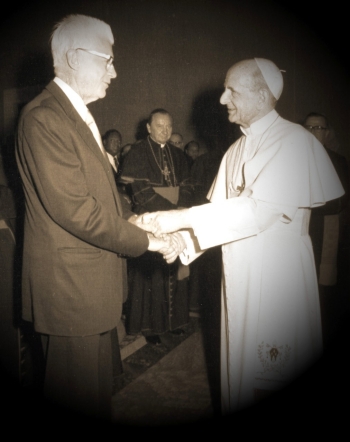 The Vice Governor General of the Order, James Joseph Norris, received in Rome by Saint Paul VI.
James Joseph Norris (1907–1976), an American layman, served as Vice Governor General of the Equestrian Order of the Holy Sepulchre of Jerusalem. On December 8, 1962, the Solemnity of the Immaculate Conception, Pope John XXIII approved the Order’s new Constitution through the Apostolic Letter Religiosissimo a monumento victoriae. Drafted by Cardinal Eugène Tisserant, the Grand Master at the time, the text consisted of 36 articles and introduced numerous innovations, including the Order’s international character and the establishment of the Grand Magisterium. On December 16, 1969, Norris was invested as a Knight Commander; on November 10, 1972, he was promoted to Knight Commander with Star; and on October 20, 1976, he received the rank of Knight Grand Cross, an honour bestowed upon only a very small number of lay people in recognition of exceptional service to the Church and the Holy Land. On April 29, his son Stephen and granddaughter Amanda Norris paid a visit to the Grand Master, Cardinal Fernando Filoni, accompanied by Dr Alessandra Scotto, the postulator supporting the opening of the diocesan inquiry into the Cause of beatification of this exemplary Member of the Order.
Born in 1907 into a deeply rooted Catholic family, James J. Norris grew up with a vision of life centered on concrete service to others. He received an excellent academic education, enriched by his experience with the Servants of the Most Holy Trinity, a movement dedicated to promoting the apostolate of the laity. A husband and father of four children, Norris served as a naval officer during the Second World War, where he witnessed the spiritual ruin into which humanity had fallen. Convinced that the Church is the cradle of one universal family, he broadened his sense of fatherhood to embrace war orphans and those in need throughout the world. Beginning in 1951, he worked closely with Msgr Giovanni Battista Montini, who later became Pope Paul VI, and with Pope Pius XII in establishing the International Catholic Migration Commission (ICMC), an organization created to coordinate the Church’s response to the migration and humanitarian emergencies of the post-war period.
As European director of Catholic Relief Services, he witnessed first-hand the dire plight of millions of displaced persons and refugees in the aftermath of the Second World War.
Personally chosen by Pope Paul VI because of his extensive humanitarian experience, Norris became the first layperson to address the Second Vatican Council. His intervention, De Paupertate Mundiali in schemate de Ecclesia in Mundo Huius Temporis, cap. IV, par. 24, urged the Church to translate her social teaching into concrete action against global inequality and extreme poverty. Addressing the Council Fathers, Norris called for “a strong appeal to action” that would lead to the creation of institutions and structures through which the Church could ensure “full Catholic participation in the worldwide struggle against poverty.” His intervention had a significant impact on the Council’s deliberations and contributed in particular to the formulation of paragraph 90 of the Pastoral Constitution Gaudium et Spes, the landmark document that defined the Church’s role in the contemporary world and her commitment to the promotion of social justice. Norris outlined a model of cooperation that would help shape policies, initiatives and institutional partnerships aimed at supporting the world’s most vulnerable populations.
The day after his intervention, Norris received a letter addressed to “our beloved son James Norris,” in which Pope Paul VI expressed his appreciation for having drawn the Church’s attention to the plight of the poor throughout the world and for encouraging Catholics to commit themselves concretely to the service of those most in need, following the example of Jesus Christ. A few days later, in what was widely interpreted as a highly symbolic gesture, one that echoed Norris’s appeal, the Pope renounced the papal tiara. The act was unprecedented and was understood as a sign of the Church’s solidarity with the poor and the marginalized, because of his intention of selling it and donating the profits to assist the poor.
As President of the International Catholic Migration Commission (ICMC) from 1951 to 1974, Norris strengthened the organization’s role as a major international voice in the field of migration, promoting the protection of the rights and dignity of migrants, refugees and internally displaced persons. Under his leadership, the ICMC steadily expanded its collaboration with national bishops’ conferences and deepened its cooperation with international institutions.
Norris served during the tenure of Cardinal Eugène Tisserant as Grand Master of the Equestrian Order of the Holy Sepulchre of Jerusalem (19 August 1960–21 February 1972). Before assuming that office, Cardinal Tisserant had served as Secretary of the Congregation for the Oriental Churches until 1959. During these years, Norris worked closely with Vatican Dicasteries to address the massive flow of refugees and displaced persons from Eastern Europe. During the Second Vatican Council, Cardinal Tisserant also served as President of the Council’s Presidium.
During the final years of his life, Norris served within the Order of the Holy Sepulchre under the leadership of the subsequent Grand Master, Cardinal Maximilien de Fürstenberg (1967–1973). Before assuming the leadership of the Order, Cardinal de Fürstenberg was Prefect of the Congregation for the Oriental Churches. In this capacity, the Belgian Cardinal was the Holy See’s principal interlocutor for humanitarian assistance and migrant resettlement programs in the Middle East and Eastern Europe administered by the ICMC, of which Norris remained president until 1974. The two men collaborated closely under the pontificate of Paul VI within the broader framework of the Holy See’s charitable activities.
When Pope Paul VI established the Pontifical Council Cor Unum in 1971 to coordinate Catholic humanitarian assistance throughout the world, Cardinal de Fürstenberg participated in its work as a member of the Roman Curia, while Norris represented American and European Catholic lay relief agencies.
On November 17, 1976, the day of his death, a prayer entitled Act of Oblation to the Holy Spirit, which Father Thomas A. Judge had composed for him fifty years earlier, was found in the breast pocket of his jacket, over his heart: “Grant that I may always hear Your voice, watch for Your light, and follow Your noble inspirations… Give me the grace to say to You, always and everywhere: Speak, Lord, for Your servant is listening.” Saint Teresa of Calcutta recognized the spiritual stature of his life, marked by a reputation for holiness (fama sanctitatis), and reflected upon it in the light of the Beatitudes in a letter addressed to his widow on November 22: “The friend of the poor (...) has gone home to God. Upon arriving in heaven, Jesus must have said to him: ‘Come home, come to Me, for I was hungry and you gave Me food, I was naked and you clothed Me, I was homeless and you took Me in.’ He did this for so many years... I was very happy to be able to attend the Holy Mass that was offered in Saint Peter’s (...).”
In light of the Catholic Church’s enduring commitment to social justice, Norris’s message has taken on renewed relevance today, prompting efforts to make Members of the Order more familiar with the life and witness of this distinguished Vice Governor General, remembered as a “Layman of Universal Charity.”
Livia Passalacqua
(July 2026)