
Spring Meeting of the Grand Magisterium – April 21, 2026


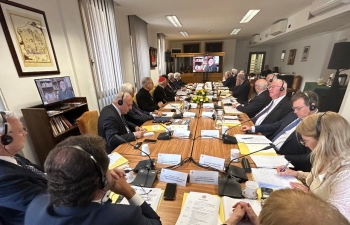
During the Mass celebrated on April 21 by Cardinal Fernando Filoni to open the Spring Meeting of the Grand Magisterium, participants prayed in particular for the repose of the soul of the Order’s Chancellor Emeritus, Ivan Rebernik, who had passed away a few days earlier. Later, gathered for a day of discussions at the temporary headquarters of the Grand Magisterium on Via Belli in Rome, they also extended their birthday wishes to Cardinal Pierbattista Pizzaballa, conveyed by the Grand Master.
In his opening remarks, Cardinal Filoni emphasized the generosity of the Knights and Dames in response to the dramatic situation unfolding in the Holy Land, where hatred and violence continue to rage. Referring to the reprehensible act of an Israeli soldier who damaged a statue of Christ—an incident widely reported in the media the previous day—he noted a growing global awareness, reflecting a universal desire to bring an end to the war in the Middle East and the abuses arising from it.
In his address, Ambassador Leonardo Visconti di Modrone, Governor General, welcomed the new Members of the Grand Magisterium: Manuel Tavares de Almeida Filho, representing South America, and Anna Maria Munzi Iacoboni, Lieutenant Emeritus for Central Italy. He also expressed gratitude for the record increase in donations from Members of the Order in 2025.
Reviewing the Order’s major events— particularly the canonization of Knight Bartolo Longo, an example of Christian life for all—he announced the upcoming meeting of European Lieutenants in Pompeii in October 2026, at the invitation of the Assessor of the Order, Msgr. Tommaso Caputo, Archibishop-Prelate of Pompeii and author of a new book dedicated to the founder of the shrine.
The Governor General also expressed satisfaction with new contacts established in India and Africa aimed at expanding the Order, and he highlighted the Order’s commitment to multilingual communication through the Grand Magisterium’s website. Addressing humanitarian emergencies in the West Bank and Gaza, he reaffirmed the Order’s full support for the Latin Patriarchate, with the goal of preserving the Christian presence in the Holy Land.
Continuing his update to the Members, he spoke about the new Foundation of the Order of the Holy Sepulchre of Jerusalem – Third Sector Body, which will support the activities of Palazzo della Rovere, the Order’s headquarters, and particularly its museum currently under development.
During the meeting, the Patriarch of Jerusalem spoke via videoconference, outlining the severe difficulties faced by local residents. “The Promised Land has become the land of promises,” he said, describing a prevailing atmosphere marked by waiting… for better days. Characterizing the situation in the West Bank as a true “Far West,” he denounced settler violence and the emergence of mafia-like practices in the administration of certain Arab cities in Israel, such as Nazareth, where the police have replaced the mayor.
The Patriarch also highlighted recent decisions by Israeli authorities invalidating the equivalence of university degrees obtained in Palestine—even those from Bethlehem University—thereby preventing, for example, Palestinian-trained teachers from working in Jerusalem. Additionally, schools in Jerusalem will be required to adopt the “Bagrut” (the Israeli matriculation system) and abandon the “Tawjihi” (the Palestinian system). Schools that do not comply will lose public funding. It is evident, he noted, that the State of Israel is asserting its intention to exercise control over the entire Holy City through increasingly strict restrictions, such as those seen during Holy Week. The Patriarch also pointed to growing problems within families, linked to male unemployment.
Referring to his forthcoming pastoral letter—aimed at situating the mission of the Mother Church of Jerusalem within the context of the conflict—he expressed sincere gratitude to the Order for its spiritual and financial support and voiced hope of attending the next Grand Magisterium meeting in person this fall.
Sami El-Yousef, CEO of the Latin Patriarchate, reviewed recent historical events that have weakened the Holy Land: the pandemic, the war in Gaza, and two conflicts involving Iran. In his detailed presentation, he underscored the severity of the healthcare crisis, noting that many people lack access to treatment – especially in Gaza, where medicines continue to be blocked. One positive development, however, is the imminent reopening of a Catholic school in Gaza.
He also denounced the expansion of settlements in the West Bank, which deprives Palestinians of their land and fuels widespread despair, as residents endure ongoing attacks from settlers targeting villages. A system resembling apartheid is taking shape, while the Palestinian Authority is being progressively stripped of its role. Tourism has collapsed and pilgrimages have ceased, making economic survival impossible for many Palestinians, El-Yousef added. In this context, the Latin Patriarchate continues to operate with perseverance, working to create jobs—particularly in the construction sector—in collaboration with West Bank parishes and Bethlehem University (AFAQ Program), and distributing food vouchers in Gaza thanks to the Order’s extraordinary humanitarian aid. Regarding the daily life of the Church, he thanked the Knights and Dames for the many funded projects, especially the renovation of Catholic schools (12 in Palestine, 25 in Jordan, and 6 in Israel, serving a total of 19,000 students), as well as for supporting the pastoral formation of laypeople, who are increasingly called to participate in the evangelization of youth.
During the discussion that followed, Cardinal Filoni quoted the words of Christ: “Do not be afraid, little flock” (Lk 12:32), emphasizing the need for the Church to bear witness to fraternity amid the cultural and religious diversity of the Middle East, in the spirit of the Abu Dhabi Document signed by Pope Francis.
In the afternoon, Treasurer Saverio Petrillo presented the 2025 financial report: approximately €27 million in revenue (including asset management), with about €6.4 million more than the previous year coming from the Lieutenancies, driven by the historic need to support Christians in the Holy Land facing war and the colonization of their lands. Of the total annual amount, more than €3.6 million was raised through the North American campaign in support of the Patriarchate’s schools.
The President of the Holy Land Commission, Bart McGetrick, revisited the virtual visit conducted last March, while Iranian responses to Israeli-American attacks were reaching Tel Aviv and occasionally Jerusalem. Praising the Patriarchate’s courageous work “under the radar”, he and the Commission members observed increasing settler aggression, severe communication challenges (with 1,000 checkpoints in the West Bank), and a worrying rise in unemployment (70%), particularly among Christians who depend on pilgrimages for their livelihoods. In this context, the mission of the Order is more vital than ever to sustain hope – especially by fostering job creation alongside the local Church and supporting education for peace.
Following internal “off the record” exchanges after valuable contributions from the Vice Governors General(1) and the Chancellor regarding the global development of the Order, the meeting concluded with a prayer to Our Lady of Palestine for the intentions of all our brothers and sisters in the Holy Land.
François Vayne
(April 2026)
(1) A further article will provide a comprehensive overview of their important contributions.