Let us not forget our brothers and sisters in the Holy Land!

Print Mail Pdf

FV_Viaggio

Returning to the Holy Places of our faith is, above all, a grace to be desired: a pilgrimage that we must wish to undertake without waiting any longer, out of love for the living stones of the Mother Church of Jerusalem. Our brothers and sisters in the Holy Land are suffering because of the absence of pilgrims, and our solidarity with them is an urgent duty. Their joy at welcoming us is indescribable, and they have a treasure to offer us.


Ten days at the heart of the Mother Church of Jerusalem:  Testimony from François Vayne.

My wife Fatima and I had decided to spend ten days in Jerusalem this summer, in solidarity with our brothers and sisters in the Holy Land, worn down by three years of war and facing isolation, particularly as a result of the absence of pilgrims. When we set out for the Holy Land, Pope Leo XIV, during the Angelus on August 16, had just called for an end to the repeated violence against the Palestinian civilian population in the West Bank, issuing an urgent appeal to the international community to make progress towards a two-state solution, with a view to a just and lasting peace.

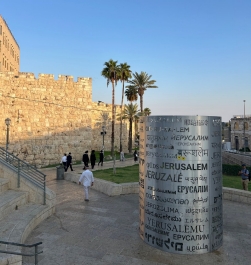
When we arrived at Tel Aviv airport in the early hours of August 20, an employee who was finishing his shift, struck by the Marian medals we were wearing around our necks, offered to accompany us to Jerusalem, paying for the train tickets himself. 
IMG_2878

A Christian Arab in his early thirties, Sami lives in the Holy City and expressed in this way the joy of our brothers and sisters in the local Church, welcoming people who had come out of love for the Holy Land and all its inhabitants.

We arrived at the Latin Patriarchate, where we were warmly welcomed, delighted to be able to share the life of the community for a few days, alongside those responsible for coordinating the work of more than 120 priests serving some 160,000 faithful. Patriarch Pierbattista Pizzaballa and the Patriarchal Vicar for Jerusalem and Palestine, Monsignor William Shomali, foster a genuine family spirit in the home of the Diocese of Jerusalem, where Members of the Order of the Holy Sepulchre and their friends feel completely at home. After all, the Patriarch is also the Grand Prior of the Order. 

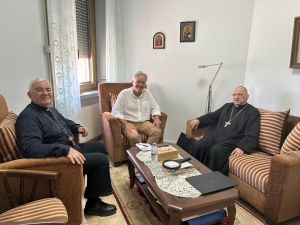
Our friend, Monsignor Giacinto-Boulos Marcuzzo, titular Bishop of Emmaus and Emeritus Patriarchal Vicar, generously offered to drive us around during our stay, both to some of the most significant Holy Places and to meet the “living stones” who are the Catholics of this land, often facing great difficulties.

IMG_3391

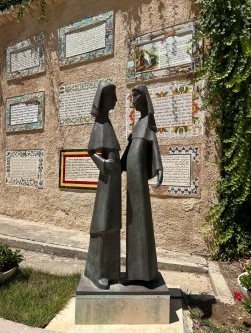
With him as our spiritual guide, we travelled throughout the region, going, for example, to pray at the tomb of Lazarus in Bethany, or on the heights of Abu Ghosh, the biblical site where the Ark of the Covenant was kept before David brought it to Jerusalem, and then into the heart of the hills of Judea, to Ein Karem, where the Virgin Mary sang the Magnificat when she visited her cousin Elizabeth, before the prophet John the Baptist, the Forerunner, was born there.

Our pilgrimage was marked by numerous stops, during which the people we met seemed to embody the charism of the places themselves. I am thinking in particular of the sanctuary of Eleona, “the Olive Grove”, near the cave where Christ taught the Our Father to his disciples, a blessed place animated by Carmelite religious sisters who, from their monastery perched on the Mount of Olives, carry the whole world in their prayers.

During meals at the Patriarchate, we discussed the worrying situation at present, and the words of hope spoken by both sides, inspired by their profound spiritual lives, deeply edified us.

How, indeed, can one remain calm in the face of the statements made by Israel’s Chief Rabbi, David Yosef, who denies the existence of the Palestinians and claims that they have never been a nation? During an event held in West Jerusalem on the day we arrived, one of the highest religious authorities in the Jewish world had calmly called for the destruction of Gaza and the complete colonisation of the occupied West Bank…

A few days later, the assailant who had attacked a French religious sister in Jerusalem was acquitted on the grounds that he was not criminally responsible because of his mental condition, while that same day, on Mount Zion, near the Cenacle and the house of Mary, my wife and I were spat at by an Orthodox Jew who had taken exception to seeing our baptismal medals…

Clearly, a great spiritual battle is taking place in the places of the Redemption. But, if we take the lessons of history into account, do the supremacists who spread hatred towards those who are different not risk, in the end, bringing about their own destruction?

IMG_3414

In this tense atmosphere, Monsignor Michel Sabbah, Emeritus Patriarch, a man of God loved by all, confided in us: “The Resurrection must remain our way of life, without allowing ourselves to be overshadowed by evil, inwardly enlightened by the love of Christ.”

At his residence, at the foot of the Mount of Olives, near the Brigidine Sisters, he repeated to us the words of Jesus in the Gospel: “Do not be afraid, little flock” (Luke 12:32), stressing that, in his view, the Church in the Holy Land is facing persecution as it did in apostolic times, and with the same confidence in the power of God, the guarantee of fruitfulness for all humanity.

The words of the Emeritus Patriarch, radiant with peace and wisdom, echoed those of Cardinal Pizzaballa, who, on the occasion of the Feast of the Assumption on August 15 in Taybeh, was commenting on the biblical texts concerning the woman and the dragon: whatever the apparent power of evil, its power is not absolute.

“We must learn from the Virgin Mary to guard our hearts, because if our hearts are corrupted, the ‘dragon’ has won,” said the Patriarch, indirectly echoing the Apostle Saint Paul, who in his writings urges us not to give the devil a foothold (Eph 4:27).

“We want to remain a life-giving community, without renouncing or abandoning our rights. So be courageous. Do not be afraid,” the Patriarch told this parish, besieged by Jewish settlers, in the last entirely Christian village.

Although we are, unfortunately, accustomed to the crises that periodically afflict the Holy Land, during this journey we found ourselves wondering whether, this time, the crisis might not have taken on an irreversible character.

IMG_3093

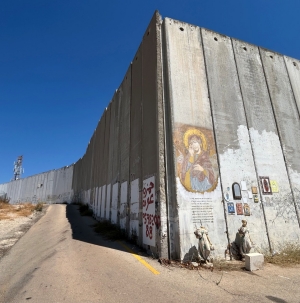
The Separation Wall is like a snake that is slowly suffocating the Palestinian inhabitants. Constantly shifting, depending on the areas of land to be incorporated, it stretches for almost 800 km, while the border between Israel and the West Bank is less than 400 km long.

Because of the Wall and the checkpoints, to travel from Bethlehem, south of Jerusalem, to Ramallah, the provisional capital of the State of Palestine, north of the Holy City, one has to travel 70 km, while the actual distance to be covered is less than 30 km.

Palestinian workers are discouraged by inhumane commuting times, while others are unemployed because they no longer have permits to travel and work in Israel, having been replaced by foreign workers, particularly Indian and Filipino citizens.

Jerusalem’s Catholic schools do not know how they will be able to continue operating, since a permit is now required for Palestinian teachers who travel to work each day from the nearby West Bank.

One of these teachers revealed to us that 200 Christian families have already left the country since October 7, 2023, exhausted by the aggression of the settlers and the humiliations they have endured, demoralised by the skilfully orchestrated interruptions to the water supply, the lack of food, the inability to pay their children’s school expenses, and the absence of any prospects.

These families are mostly descendants of Palestinians expelled from the 500 villages destroyed by Zionist militias in 1948 and who sought refuge in the West Bank, like the inhabitants of Ein Karem, the celebrated home of the Forerunner, once populated by Arab Christians and today inhabited mainly by Jewish families.

We found that a veritable strategy of strangulation is under way in East Jerusalem and the occupied West Bank, while the world is rightly concerned about the fate of Gaza's martyred population.

IMG_3965

The 8,000 Christians living in Jerusalem, of whom 4,000 are Latin Catholics, generally poor, dream of nothing but emigrating and, if this situation continues, the Holy City will be deprived of their presence within some fifteen years, we were told.

Is it definitively impossible for some seven million Jews and seven million Palestinians to live together in the same territory between the River Jordan and the Mediterranean Sea?

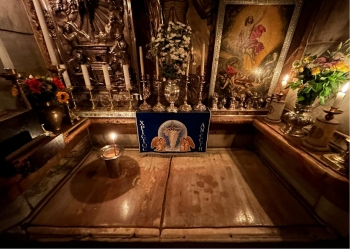
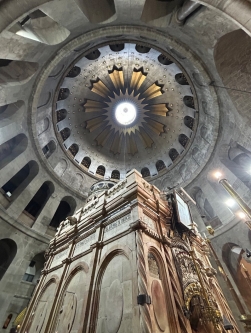
On the eve of our departure, Friday August 28, as we once again went down to pray in the Basilica of the Holy Sepulchre with the Franciscan friars, entrusting numerous people’s intentions to God, we encountered with emotion and respect Muslims returning from prayer on the Temple Mount and Jews making their way to pray at the Kotel, or Western Wall.

This “interweaving” of believers turning towards the one God confirmed within us the certainty of Jerusalem’s universal vocation, a heritage belonging to all humanity.

A mysterious hope remains very much alive in the hearts of the Holy Land, and it is up to us to nurture it through our visits and our friendship, like a small flame capable of illuminating the darkness of history.


François Vayne


(September 1, 2026)