
From Taybeh, a warning signal is alerting us


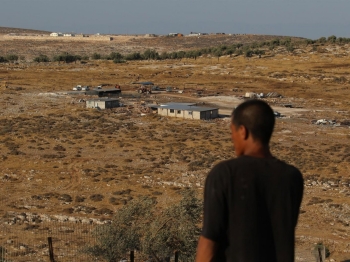
Gonçalo Figueiredo de Barros, Honorary Lieutenant of the Order of the Holy Sepulchre for Portugal, has written the following article about the ordeal being endured by the last entirely Christian village in the Holy Land. We are publishing it here for the attention of Knights and Dames throughout the world, in order, on the one hand, to highlight the Order’s constant commitment to supporting the Christian presence in the Holy Land and, on the other, to pay tribute to those baptised in Christ living there. Our brothers and sisters in Taybeh and other villages in the occupied West Bank, are courageously facing repeated attacks that threaten the survival of their community. Let us not abandon them!
There are places that say far more than what can be seen. Taibeh, a small Christian village in the West Bank, is one of them. When its inhabitants are subjected to attacks, arson, destruction of property, threats to their land, and the fear of new Israeli settler outposts, what is at stake is not merely the fate of a small community of around 1,500 people. The issue is far deeper and concerns the future of Christians in the Holy Land.
Taibeh, ancient Ephraim, the place where, according to the Gospel of John, Jesus took refuge with his disciples before the Passion, is today the last entirely Christian village in the West Bank. But its true significance lies not merely in the percentage of Christian inhabitants, nor in the ruins of the Byzantine Church of St George, whose origins date back to the fifth century. It lies instead in the fact that there is still a community there that is not an archaeological relic, but a living population, with families, children, the elderly, professionals, farmers, schools, jobs, faith and hope.
It is precisely this dimension that is so often missing from the media and political debate about the Holy Land: much is said about territories, borders, security and major political and military conflicts, but little about the concrete human beings who, for centuries, have given substance and life to its history.
It is worth remembering that Christians preceded Muslims in Palestine, as Riyad Al-Maliki, the former Palestinian Authority Minister of Foreign Affairs, pointed out in 2021, and that they share a common past with Jews through the Old Testament. The Church of Jerusalem is the Mother Church, born at the very heart of the founding events of Christianity. There the Gospel, the Passion and the Resurrection were proclaimed; from there the Apostles set out. Saint John Paul II repeatedly recalled the responsibility of the whole Church towards this community. Pope Benedict XVI likewise emphasised the particular mission of the Christians of the Holy Land in building harmony among different communities.
For this reason, protecting Christians in the Holy Land does not mean preserving a kind of collection of religious objects. It means defending the living stones of the Holy Places. A basilica may remain standing; a church may be restored; an ancient inscription may be preserved. But if the families, children, schools and parishes disappear, the Holy Land risks preserving its monuments while losing its soul.
The figures speak for themselves and should prompt serious reflection. According to published official data, Christians represented around 11% of the population of Palestine in 1925; 8% in 1950; 3% in 1975; 2% in 2000; and less than 1% in 2025. In Bethlehem, the transformation is even more dramatic: from 86% in 1950, their share is estimated to have fallen to less than 8% in 2025.
This is not merely a demographic issue. Behind these figures lie decades of emigration, economic hardship, conflict, insecurity and wounds that have been slow to heal. Above all, there is a younger generation beginning to ask whether there is still a future for them in the land where their parents and grandparents were born. The problem becomes even more acute when young people compare, through the internet and television, their circumstances with the lifestyles of young people in other parts of the world.
This is where the silence becomes particularly troubling. The decline of the Christian presence rarely receives media attention proportionate to its historical and human importance. Christians are a peaceful minority and, precisely because of this, they have less ability to make their voices heard. But a silent minority is not a dispensable minority.
Taibeh has made this tragedy visible. The recurring attacks that began in 2025 and continued into 2026, the threats to property and land, and the insecurity felt by residents show how violence can produce an even deeper consequence than the immediate damage: convincing a family that it is no longer possible to build a normal life there.
The visit of the Latin Patriarch of Jerusalem, Cardinal Pierbattista Pizzaballa, to Taibeh last August therefore had a significance that went beyond that village. Pizzaballa stated that the Church would do everything within its power to preserve the Christian presence in the Holy Land. And he delivered a message that was at once spiritual and profoundly human: to remain, to live, not to abandon the right to life, to be courageous and not to give in to fear.
But the fact is that the Church cannot do this alone.
The Latin Patriarchate of Jerusalem has carried out essential work in supporting local communities, while the Church's network of institutions — from the Franciscans to the Equestrian Order of the Holy Sepulchre of Jerusalem, from Aid to the Church in Need to Caritas and other aid organisations — demonstrates that charity and assistance cannot remain mere intentions. Schools, hospitals, housing, employment, agriculture, small businesses and initiatives that give young people concrete reasons to stay all need support.
Pilgrimages, too, can be an extraordinary form of communion and support. Not religious tourism, as if visiting a museum, but an encounter with a living Church. Going to the Holy Land, praying with its communities, learning about their difficulties, buying from their shops and bazaars, visiting their institutions and showing Christians that they have not been forgotten is a concrete way of standing with the Mother Church of Jerusalem.
The international community also has obligations. It is not enough to condemn violence. It is necessary to work towards creating political, diplomatic and economic conditions that enable families to live in security, freedom, dignity and with prospects for the future.
We cannot accept the idea that the disappearance of Christians is inevitable. There is a political dimension that cannot be ignored. The Christian presence is also a factor of humanisation and stability in a region marked by polarisation, violence and mistrust. The values that Christians seek to embody — the dignity of every person, respect for others, religious freedom, forgiveness, charity, education and peaceful coexistence between communities — can make a concrete contribution to rebuilding bridges where walls exist today. Defending their continued presence is therefore not merely a religious or humanitarian issue: it is also an investment in a more pluralistic, more balanced society, one better able to find paths towards peace.
The Holy Land does not belong exclusively to one religion, one people or one narrative. It is a place of encounter, precisely because histories, cultures and traditions converge there. Christians can and must be part of that coexistence. Not as spectators to the conflict, but as “salt, light and leaven,” in the words of Cardinal Pizzaballa.
Taibeh is a sign and a starting point. The real question is the whole of the Holy Land.
And perhaps it is time for the world to understand that defending the Christian presence does not mean choosing one side against another. It means choosing human dignity, plurality, memory and the possibility of a shared future.
Because a Holy Land without Christians could continue to have churches, shrines and ancient stones. But it would be a profoundly poorer Holy Land, where Christ, after Judas's betrayal, would be betrayed once again.
Gonçalo Figueiredo de Barros
Honorary Lieutenant for Portugal
(September 2026)