The Holy Land Commission’s autumn visit

In contact with a community striving to remain in the Holy Land

Print Mail Pdf

holy-land-commission-fall-visit-2026_55571048641_o

The regular half-yearly visit of the Grand Magisterium’s Holy Land Commission began earlier this October against a painful backdrop. On 3 October, in fact, two Christian women were killed in a bombing in Gaza, where the community of Christ’s faithful has been cut in half over the past three years, now numbering 539 baptized Catholic and Orthodox Christians.

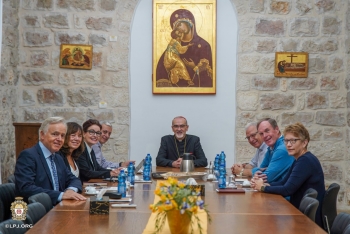
In the absence of the Commission’s president, Bart McGettrick, who was unable to attend for health reasons, Donata Maria Krethlow-Benziger, appointed ad interim president by the Grand Master, leads the work of the Commission, of which she is a member along with Tim Milner. Accompanied by Tim Milner's wife, Donna Milner, François Vayne, head of communications for the Grand Magisterium, and Connie Kimberger, they met on Monday morning with His Beatitude Cardinal Pierbattista Pizzaballa, who strongly emphasized the priority of humanitarian aid, especially in Gaza, but also in the West Bank and the Old City of Jerusalem. 

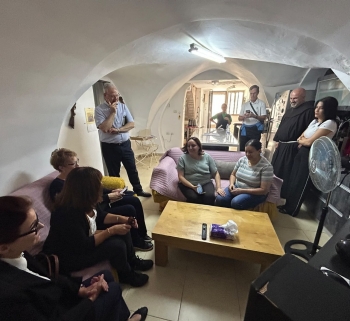
The members of the Commission then discussed this issue with the administrative and management staff of the Latin Patriarchate of Jerusalem, before visiting needy Christian families living in the Old City of Jerusalem—families supported, in particular, by aid sent by the Order to the local Church. These families expressed their gratitude for the assistance provided, including food coupons and the payment of school tuition for their children’s education, as well as the creation of jobs linked in particular to the activities of the Catholic parish of St. Savior in Jerusalem.
IMG-20261005-WA0029

That same afternoon, the Patriarchate’s general administration provided a detailed update on the projects supported by the Order prior to a video conference with the parish priest of Gaza, Father Gabriel Romanelli.

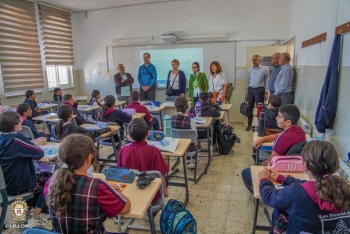
The following day, the visit by the Grand Magisterium’s Holy Land Commission continued in Nazareth, Israel, where the Commission members met with Father Ibrahim Shomali, parish priest of Reneh and director of the Catholic schools in Israel. Father Shomali described the situation at the country’s five schools, which have more than 5,000 students, 90 percent of whom are Christian. The Israeli government is providing less support to these institutions than before, perhaps due to the war effort. Support from the Order is therefore needed, especially for the maintenance and restoration of these schools, which serve as vital centers for catechesis and the transmission of the faith—sometimes leading to conversions and requests for baptism.

Later, Bishop Rafic Nahra, Patriarchal Vicar for Israel, welcomed the members of the Commission and he told them about the devastation caused by the local mafia in the Arab-Israeli community, which is driving many Christians to emigrate, frightened by the threats against them, with no help coming from the police. This difficult reality in Israel is accompanied by a growing phenomenon of aggressions against Christians by extremist Jews, especially on the streets of Jerusalem, and reports of attacks and violence in places such as Taybeh in Palestine that the Commission visited in the days that followed. In this context, Bishop Rafic asks all members of the Order for their prayers and solidarity through the pilgrimages they will organize, hoping that this will raise awareness of the injustices that are weakening the Christian community in the Holy Land.

In other respects, there is a real vitality within the Hebrew-speaking Catholic community, made up of foreign workers in Israel, even though these people—often in precarious situations—are not expected to remain there long-term.

holy-land-commission-fall-visit-2026---day-3_55575393270_o

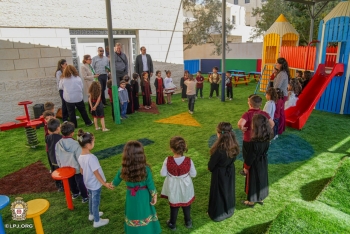
On October 7, the Commission travelled to Palestine, to the Bethlehem area, where they met with Anton Jaraysah, the principal of the Catholic school in Beit Sahour—the village of the Christmas shepherds—who described the efforts being made to enable the school’s 380 students to continue their studies. Indeed, the absence of pilgrims over the past three years—due to the war— and the inability of Palestinians to work in Israel have caused devastating unemployment, making it very difficult for many families to pay tuition fees. These fees are largely covered by financial support from the Order sent to the Latin Patriarchate, notably through a special fundraising campaign conducted in the United States. The school’s principal emphasized that 30 percent of the students are Muslim since their parents prefer a Catholic education for their children.

The Commission then visited Bethlehem University, which is home to 760 students facing uncertainty about their professional future. Vice-President Iman Saca thanked the Order for the assistance provided to this educational institution which trains the future leaders of this country, which is under constant pressure. The AFAQ project, carried out since the pandemic - and then the war - in collaboration with the Latin Patriarchate and the Order of the Holy Sepulchre, enables many university graduates to find work in Palestine or Jerusalem in the medical, social, or economic fields. In the afternoon, the Commission also visited the seminary in Beit Jala—the “heart” of the Diocese of Jerusalem—where the Patriarchate’s future priests are trained, and whose operating costs are regularly covered by the Order. The priests of the Patriarchate—in Israel, Palestine, Jordan, and Cyprus—are most often responsible for coordinating pastoral care in schools affiliated with parishes and are therefore very directly involved in the spiritual formation of students and in the education for peace that characterizes these schools, where Christians and Muslims grow up together.

holy-land-commission-fall-visit-2026---day-4_55576115747_o

40,000 Christians still live in Palestine; their situation is becoming increasingly difficult, particularly due to the absence of pilgrims and tourists, and the fact that Palestinians are unable to travel and work in Israel. More than 200 Christian families have left the country since 7 October 2023, and the exodus is continuing. In Taybeh, the ancient Ephraim mentioned in the Gospel (John 11:54), which is the last entirely Christian village in the Holy Land, Father Bashar Fawadleh, the parish priest, described the efforts being made to create local jobs and build housing for the community, in collaboration with the Latin Patriarchate and the Order of the Holy Sepulchre, in order to slow down emigration. The parish school in Taybeh now has 70% Muslim pupils out of a total of 400 registered. The proportion has inverted in the last 10 years due to Christians leaving for the United States, Latin America and Spain. Pointing out the psychological impact of repeated attacks by extremist Jewish settlers, who harass villagers and destroy olive groves without fear of reprisal, Father Bashar made a moving appeal to the members of the Order: “Come to Taybeh on pilgrimage; don’t wait – come in large numbers to support us and help us prepare for the Jubilee of Redemption, which will take place in 2033.” The Commission then visited Beit Afram, the elderly house of the Latin Patriarchate, where Monsignor Michel Sabbah, Patriarch Emeritus of Jerusalem, lives amongst some thirty very elderly residents, many of whom are cared for with the support of the Order.

The day continued in Ramallah, capital of the State of Palestine, where the largest parish has 700 families and 3,000 parishioners. The members of the Commission took part in an important meeting with the parish priest, Father Yacoub Rafidi, who is also director of the Patriarchate’s 12 schools in Palestine. He insisted on the need to continue to welcome young Christians, who represent nearly 40% of the students and who all wish to remain in the land of their ancestors in the future. In Ain Arik, finally, the Commission met with Father Firas Abderabbo, who is deeply committed serving young Christians in Palestine who are seeking hope in a country that the separation wall is turning into a large concentration camp.

On Friday October 8, the Commission’s visit concluded with a series of meetings in Jerusalem, in particular with officials from the Vicariate for Migrants, before a closing ceremony at the Nunciature.


François Vayne

(October 2026)